
Kaiwen Wang's e-Portfolio
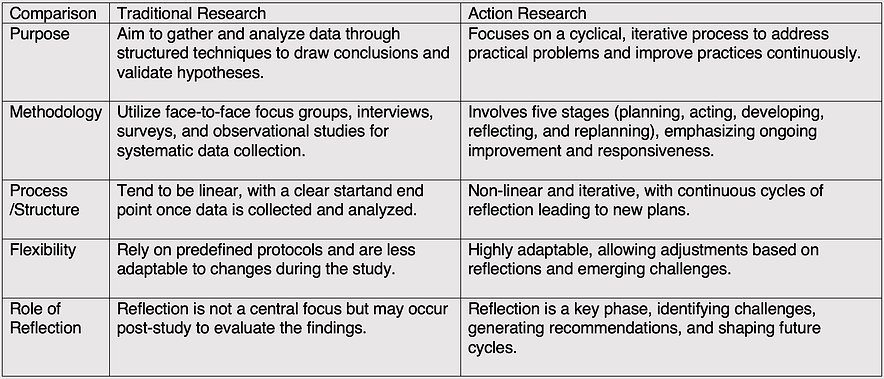
Traditional Research vs Action Research
-
Traditional Research:
Traditional research seeks to advance knowledge by forming hypotheses, building on theories, and analyzing data from randomly selected samples using qualitative, quantitative, or mixed methods (McMillan, 2015). In my view, traditional research offers valuable insights into general educational trends. For example, an instructional designer might test two teaching methods, such as traditional lectures and interactive multimedia, to see their impact on student learning. Participants are randomly assigned to each group, with all variables controlled except the teaching method. Pre- and post-tests, along with other assessments, compare learning outcomes to determine which method is most effective for achieving learning goals.
-
Action Research:
Action research focuses on improving teaching and learning by investigating real-world practices, involving participants from educational environments, and emphasizing practical applications through qualitative, quantitative, or mixed methods (Mertler, 2019). In my view, action research empowers K-12 teachers to solve immediate challenges. An example of action research in instructional design could be when a teacher decides to use a new blended learning strategy in their classroom. The teacher gathers information about how engaged the students are and how well they are performing. Then, the teacher looks at this data, makes changes to the strategy, and improves it based on student feedback. This process is repeated, helping to improve the teaching methods and, in turn, student results over time.
Reference:
McMillan, J. H. (2015). Fundamentals of educational research (7th ed.). Pearson.
Mertler, C. A. (2019). Action research: Improving schools and empowering educators (6th ed.). SAGE Publications.
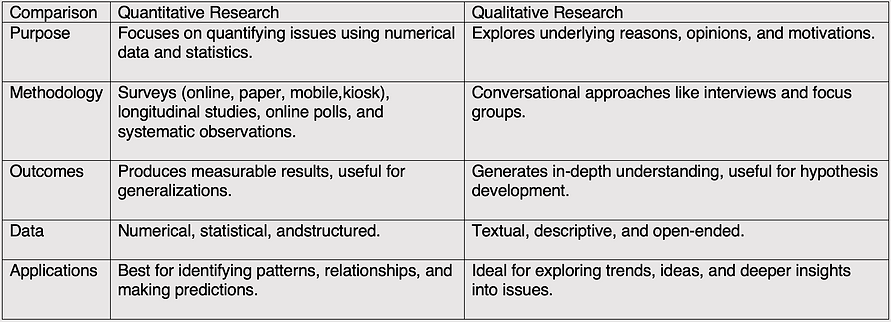
Quantitative Research vs Qualitative Research
Quantitative Research: quantitative research involves the use of numerical data to analyze and describe phenomena, aiming to address particular questions or hypotheses (McMillan, 2015). From my perspective, quantitative research helps track students' math progress by analyzing test scores and identifying trends, like which topics need more focus to improve overall class performance.
Qualitative Research: qualitative research focuses on exploring the causal connections between multiple phenomena through the deliberate adjustment of factors that affect these phenomena (McMillan, 2015). From my perspective, qualitative research offers insights into how group discussions versus individual tasks enhance engagement in lessons, helping to choose teaching methods to meet student needs effectively.
Reference:
McMillan, J. H. (2015). Fundamentals of educational research (7th ed.). Pearson.
My Action Research Report (ETEC 5430)
My action research report explores the perceptions of 4th-grade students at Irvine Chinese Immersion Academy regarding the flipped classroom model. By combining quantitative and qualitative methods, the study evaluates the model's effectiveness in improving student engagement, comprehension, and interaction, highlighting its potential for fostering active learning and innovative teaching practices.
My Reflection
Through the action research report on the flipped classroom model, I learned the practical application of qualitative and quantitative methods. Quantitative research helps analyze patterns, like how many students understand specific techniques, while qualitative research provides deeper insights into their experiences. As a K-12 teacher, this knowledge will help me assess teaching strategies, like using pre-class videos, and improve classroom engagement by tailoring instruction to student needs. It equips me to blend data-driven decisions with contextual understanding, ensuring effective and innovative teaching practices.